Matérn Noise for Triangulation-Agnostic Flow Matching on Meshes

ACM Transactions on Graphics (SIGGRAPH 2026)
1Université de Montréal & Mila, 2Brown University
Generated elastic equilibrium states

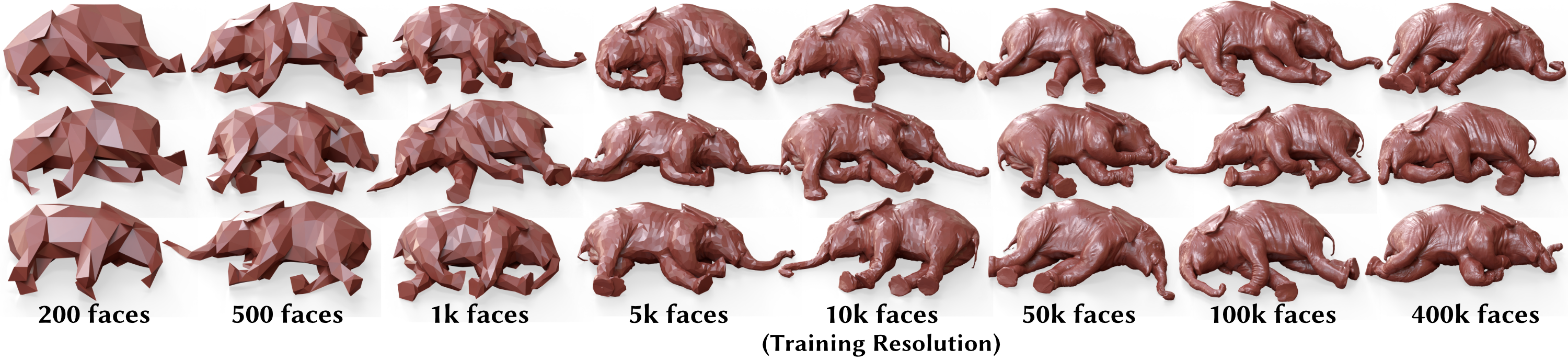
Generating different elastic equilibrium states through triangulation-agnostic flow matching.

Abstract

This paper tackles the task of learning to generate signals over triangle meshes in a triangulation-agnostic manner, meaning the trained model can be applied to different meshes and triangulations effectively. This property is critical for real-world applications, as it enables operating over heterogeneous triangulations, and yields significantly more efficient performance, enabling generation over large (one million faces) meshes.

Practically, the paper adapts the flow matching (FM) paradigm to a mesh-based, triangulation-agnostic setting. Theoretically, it proposes a specific noise distribution which is triangulation agnostic, to be used inside the FM model's denoising process. While noise distributions are usually trivial to devise for, e.g., images, devising a triangulation-agnostic distribution proves to be a much more difficult task. We formulate a mathematical definition of triangulation agnosticism of distributions, via their spectrum. We then show that a discretization of a specific Gaussian random field called a Matérn process holds these desired properties, and provides a simple and efficient sampling algorithm. We use it as our noise model, and adapt FM to the triangulation-agnostic setting by using a state-of-the-art approach for learning signals on meshes in the gradient domain—PoissonNet—as the denoiser.

We conduct experiments on elaborate tasks such as sampling elastic rest states of an object, and generating different poses of arbitrary humanoids. Our method is shown to be capable of producing highly realistic results for meshes of over one million triangles, significantly exceeding the state-of-the-art in quality and diversity.

What's our proposed Matérn noise  on meshes?

Matérn noise vs. iid Gaussian

Our Matérn noise is triangulation-agnostic, meaning that it yields similar distributions for different discretizations of the same underlying surface. See the figure for visual comparisons of our Matérn noise with simple iid Gaussian on different meshes.

How to sample Matérn noise?

Matérn noise $\textbf{f}$ is sampled by solving a screened Poisson equation as:

$$ (\textbf{L} + \boldsymbol{\tau}\textbf{M})\textbf{f} = \textbf{M}\textbf{w}, $$

where $\textbf{L}$ and $\textbf{M}$ are the mesh's cotangent Laplacian and lumped mass matrix, $\textbf{w} \sim \mathcal{N}(\textbf{0}, \textbf{M}^{-1})$ is a white noise sample, and $\boldsymbol{\tau}$ is the user-chosen screening term controlling the amount of higher frequency content in the noise (see the figure for how it affects the noise distribution). Check our paper for details on Matérn noise.
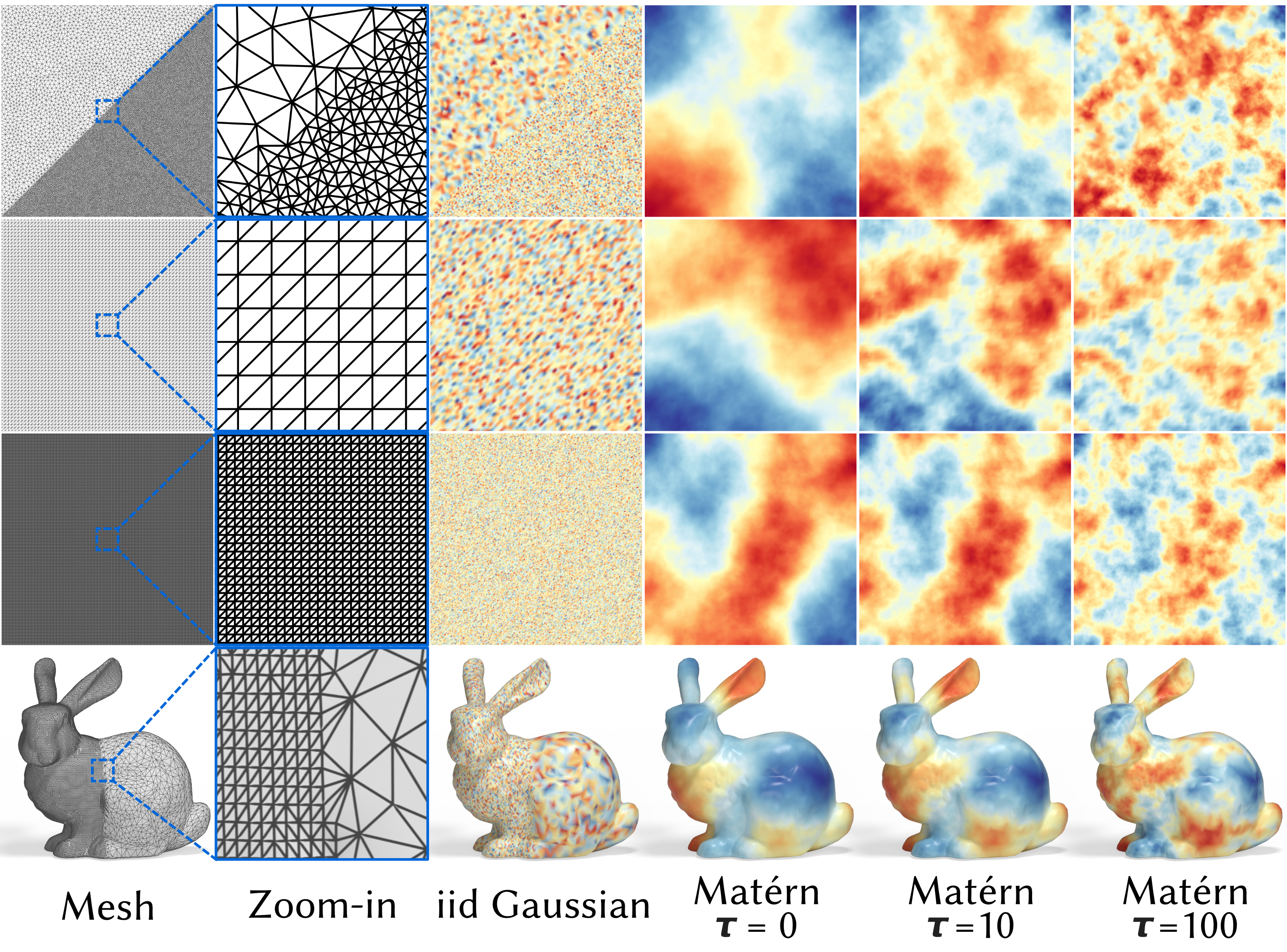

Matérn noise visual comparison
Top 3 rows: different discretizations of the same 2D square.
Bottom row: a non-uniformly triangulated Stanford bunny.

Overview

Overview

Overview of triangulation-agnostic generative pipeline. We first perform noise sampling (left) from our proposed triangulation-agnostic Matérn noise distribution. We then use that noise as the initial signal $\textbf{f}_0$ in a flow matching denoising process (middle), which iteratively denoises the signal into the final sample $\textbf{f}_1$. In each flow step (right) we input the current signal $\textbf{f}_\text{t}$ into PoissonNet, which predicts the current momentary velocity $\textbf{v}_{\text{t}}$. An ODE step time-integrates the velocity, starting from the current signal $\textbf{f}_\text{t}$, to obtain the next signal $\textbf{f}_{\text{t}+\Delta \text{t}}$. This continues until reaching $\text{t}=1$.

Flow matching denoising process

Triangulation-agnostic generation

Generated elastic equilibrium states (model only trained on 10k-face resolution)

Triangulation-Agnostic Generation

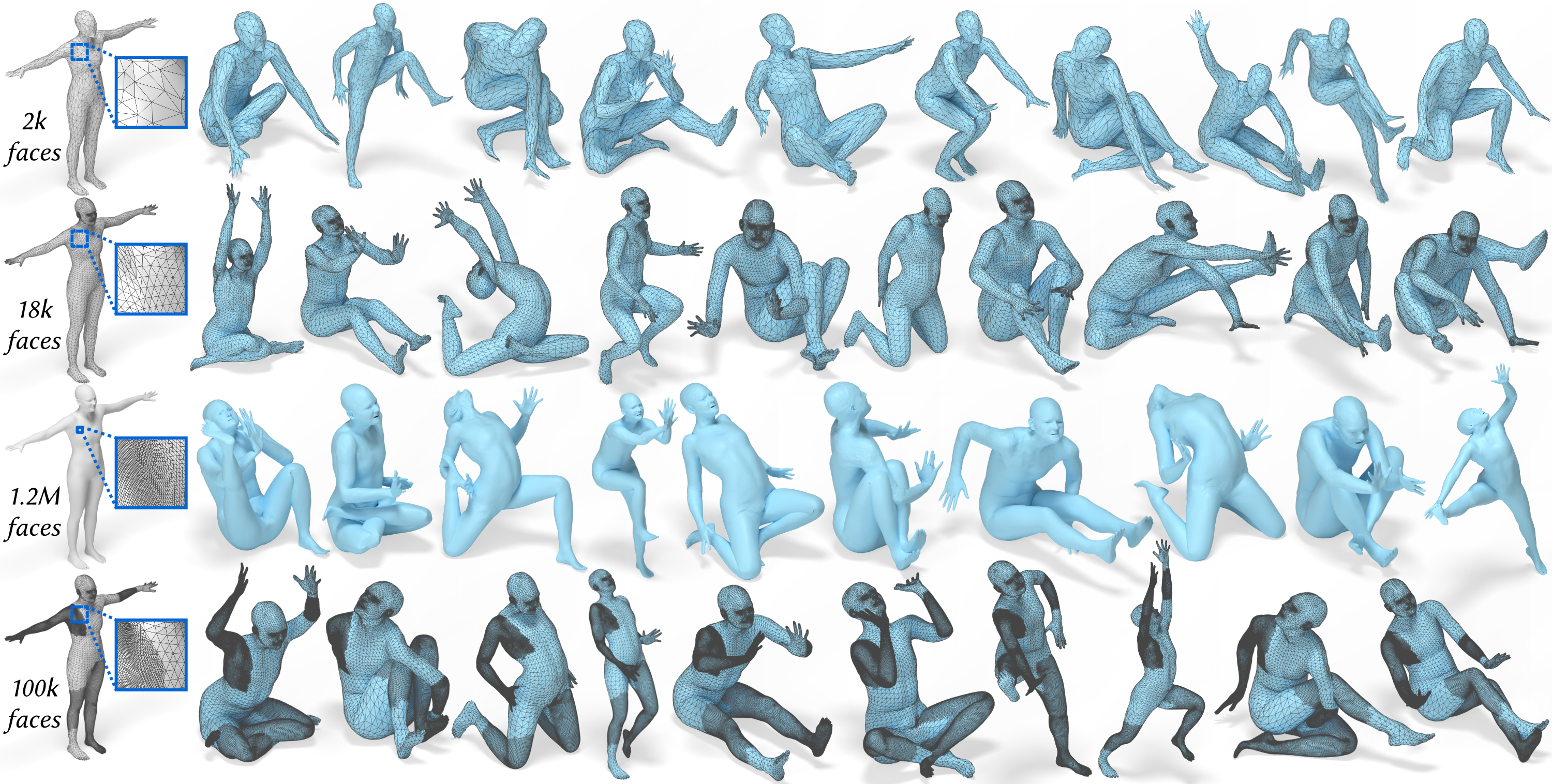
Generated yoga poses of SMPL human (model only trained on 18k-face resolution)

SMPL poses

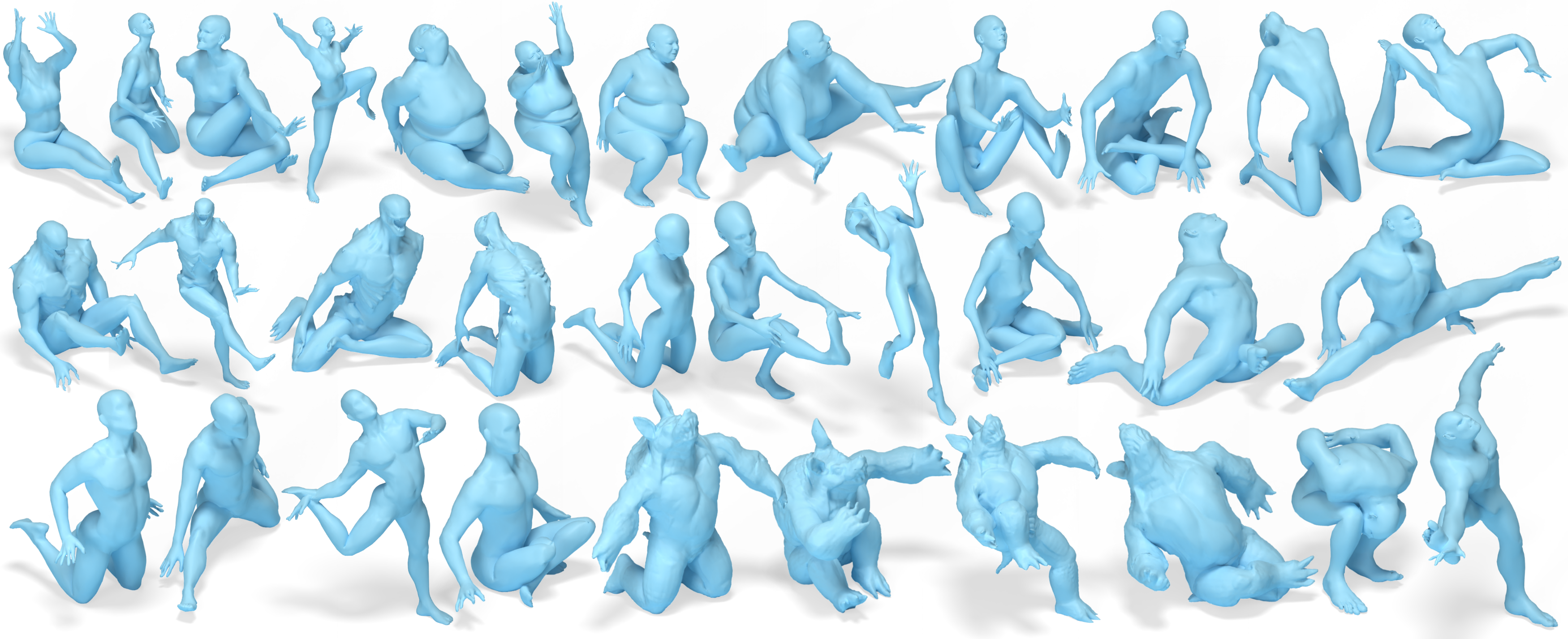
Generated yoga poses of unseen humanoid meshes

Unseen humanoid poses

BibTeX

@article{kuai2026matern,
  author    = {Kuai, Tianshu and Maesumi, Arman and Ritchie, Daniel and Aigerman, Noam},
  title     = {Matérn Noise for Triangulation-Agnostic Flow Matching on Meshes},
  journal   = {ACM Transactions on Graphics (Proceedings of SIGGRAPH 2026)},
  year      = {2026},
}